

“And look at what I saw! A bobcat!” my St. Lawrence University professor said, excitedly showing a blurry photo of a bobcat camouflaged in heavy white snow as I turned my Zoom camera on for our discussion. Hmm a bobcat, I thought, a little perplexed. What is a bobcat? It should then come as no surprise to you that I spent the rest of our class session thinking and later researching about this new-to-me animal. Word association played a role here; when I hear cat, I think of my cat, and subsequently, home. Besides, doesn’t bobcat have such a nice ring to it? And obsessively researching bobcats yielded a fruitful result for bobcats and I are a match made in heaven.
We are both shy creatures: at times, you can’t extract a word out of me and our friend the bobcat can’t really be seen. Nature Up North Director Dr. Erika Barthelmess told me that she has lived in the North Country for 22 years and has only seen a bobcat once! I have never laid eyes on one. We are both nocturnal: I roam around the St. Lawrence University campus most frequently at 10pm and bobcats roam around at night looking for their prey. Both of us are fairly adaptable to our environments though; some days I’ll be an early bird, and some days bobcats will hunt during daylight. Whatever the environment throws at us, we will take and run with it.
We are secretive: I think of myself as private or even mysterious, and bobcats sneak up on, wait, no matter how long, in silence for the perfect moment, and dart at their prey in a flash. The naturalist/writer Rob Rich called the method the stalk-crouch-wait-POUNCE, and hardly anything could top that description. Finally, our friend bobcat and I are solitary: being by ourselves is the most comfortable state of being. Until we need others. Somedays, to fully be me, I exchange cozying under my heavy comforter with meeting friends. Bobcats, to fully be animals, step out of their loner shells and track each other down to mate. They are, after all, the most abundant wild cat in North America!
The mating season is December through March, but in reality, bobcats mate from January to July. One can find a pregnant female at any time of year. When the time comes, bobcats leave their dens (which are distinctly marked by the urine they sprayed on scent-absorbing moss and leaves at the entrance) to find and mate with more than one female. In fact, a male bobcat mates with as many females as possible. No wonder, then, that the male’s home range is larger than that of the female – each guy really attempts to maximize his breeding opportunities!
The female, on the other hand, is “in heat” and awaits a male. “In heat” here just means that she’s ready for mating (sounds so R-rated, doesn’t it?). She may also scent mark her den to signal the suitors, and in return, the male would utilize his olfactory investigation skill, one of their more favorable communication behaviors, to find her.
Once a male finds a female, a series of activities will occur. The female will arch her back and yowl a bit to signal that she’s ready to mate. Then it gets physical: the pair would chase and pounce on each other for a while before the male bobcat bites her neck and mating commences. If the female doesn’t want to mate, she will fight back, and subsequently, the male departs with a split ear. The males also must fight the same-sex competitors to gain access to females – these fights cause loud noises that you can occasionally hear if you decide to take a walk in the woods.
The raising of the litter falls entirely on the mother since the male leaves immediately after breeding to pursue other females. Bobcat natal dens are therefore usually discreet. Hunters have found these special hideouts in crevices and holes in rocks, hollow logs, and under large cedar trees.
Research shows that female bobcats gestate for 63 days or more. The young bobcats are called bobkittens! A litter has between 1-7 bobkittens and an average of 3.2. Due to the short gestation, the kittens are blind when born. However, bobkittens’ eyes open after 10-11 days and turn blue (and then eventually yellow – which is devastatingly cool!). Their teeth start showing right after the eye-opening period and are expected to be completed by 9 weeks.
A litter is nursed by a female bobcat for two months. After the 8th week, they will venture out of the den and start hunting. However, learning to hunt takes a long time so some young bobcats could die due to starvation during the training period. The litter does stick around with their mother, especially when the resources are abundant. Once bobcats are old enough to leave, the cycle repeats itself: they either become the neck-chewer or the neck-chewed when it’s time to reproduce.

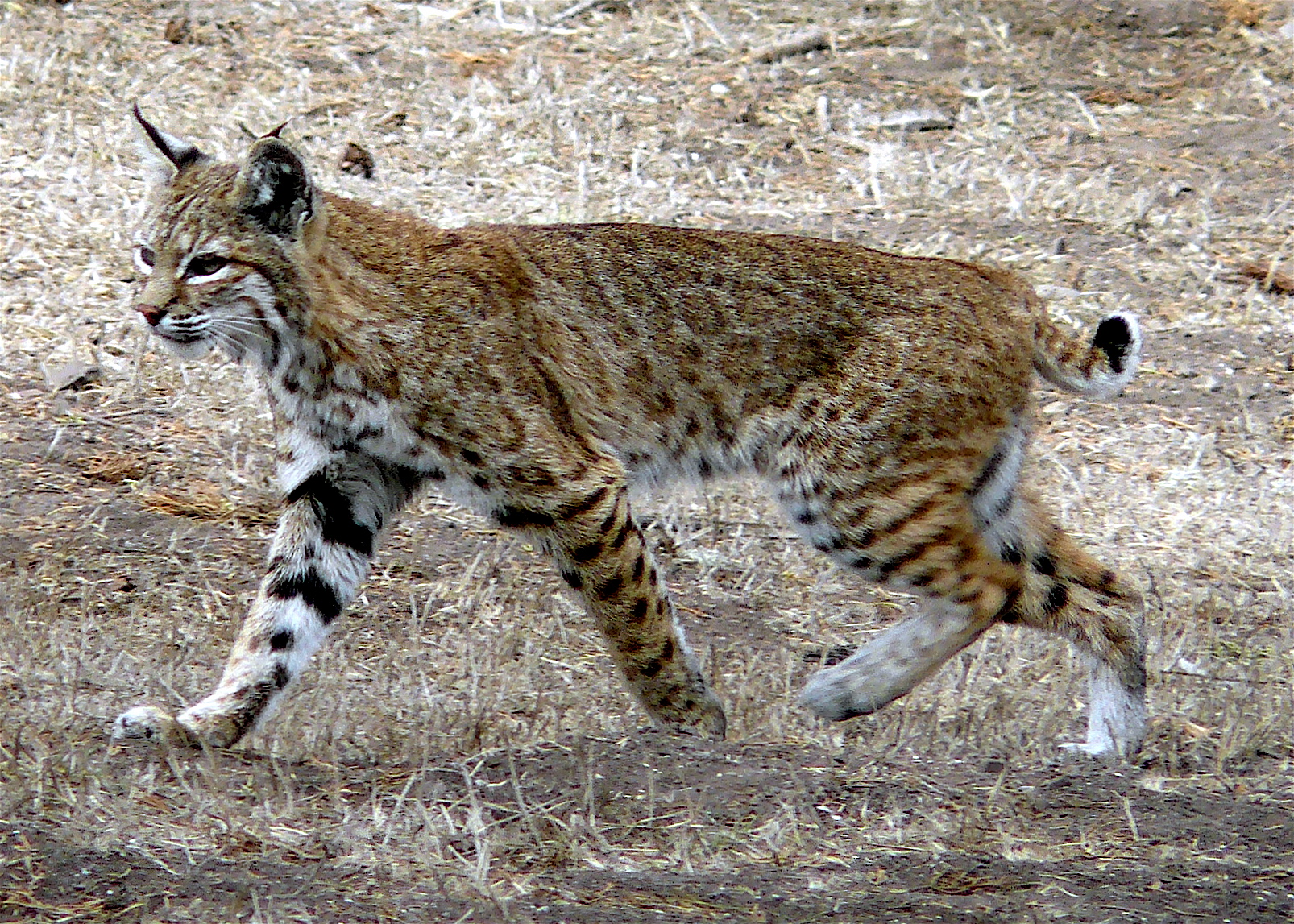
A bobcat was discovered living in a woodshed and was photographed by Kevin MacKenzie. Photo courtesy of Nature Up North.
Female bobcats are model mothers: they care for the young even in trying times. Nevertheless, mothers will abandon their young without a fight when encountering humans or dogs. However, as the bobkittens grow old enough, the mother will fight back when encountering danger to herself and/or to her offspring. Imagine snaring and hissing – that’s her tactic.
So, why should we care about bobcat mating behavior? First, because it’s so interesting! Second, because we live in the North Country with bobcats, I think it is good that we know a bit about our neighbors. And third, we might sometimes hear bobcat mating – and trust me – after watching a couple of videos on bobcat mating, I know that the wailing and yelling sounds like a child or a woman crying, which is alarmingly worrisome! So, if you hear shrieking at 2 or 3am on a sleepless night or while walking around on one of the more hidden trails in the NoCo, settle the jolt in your heart and remind yourself that the sound is simply nature in its purest form. And if you are accompanied by your dog, best to stay on course to not frighten or disturb these wonderful short-tailed friends.
References
Allen ML, Wallace CF, Wilmers CC. Patterns in Bobcat (Lynx Rufus) Scent Marking and Communication Behaviors. J Ethol 2014 Dec 18;33(1):9.
Bouchey. Prowler of the Night (bobcat). Ogdensburg (NY): Nature Up North; [accessed 2021 Oct 25]. https://www.natureupnorth.org/encounter/hunter441/prowler-night
Duke, K. L. 1949. Some Notes on the Histology of the Ovary of the Bobcat (Lynx) with Special Reference to the Corpora Lutea. Anatomical Record, 103:111-132.
eMammal. Bobcat Mating. emammal.wordpress.com. 2017 May 17 [accessed 2021 Oct 1]. https://emammal.wordpress.com/2013/11/01/bobcat-mating/
Gashwiler JS, Robinette WL, Morris OW. Breeding Habits of Bobcats in Utah. Journal of Mammalogy. 1961 Feb 01;42(1):76-84.
MacKenzie K. Another Front Yard Encounter (bobcat). Long Lake (NY): Nature Up North; [accessed 2021 Oct 25]. https://www.natureupnorth.org/encounter/kevin-mudrat-mackenzie/bobcat-photos-another-front-yard-encounter
Lariviere S, Walton LR. Lynx Rufus. 1997 -10-24(563):1.
Rich R. Winter Bobcat, watching. Center for Humans & Nature. [accessed 2021 Oct 1]. https://www.humansandnature.org/winter-bobcat-watching
Yery EK. The Bobcat – Master of the Art of Concealment. Wildlife Rescue League. 2018 Oct 2 [accessed 2021 Oct 1]. https://www.wildliferescueleague.org/animals/the-bobcat-master-of-the-art-of-concealment/
 Thao Nguyen
Leave a comment